Producers
In the Basque Country there is respect for the way of life of our producers, respect for their efforts to supply us with quality products, to maintain traditions, to help the ecological balance of our environment with sustainable production both in orchards, on farms, in the vineyards or fishing on our coasts.
This traceability in the quality of the products is what we want to convey in Basquetronomy when it comes to exporting, we want the stories of the families behind our products to be known by the final customer. Here you will be able to meet the people behind the products that you are going to taste.

Txakoli is a unique wine, it does not exist anywhere else in the world other than the Basque Country. Its characteristics are defined by the type of Hondarrabi Zuri (White) and Hondarrabi Beltza (Black) grapes, in addition to the location of its vineyards, normally around 400 meters high, its balanced acidity and its proximity to the sea.
There are three regulatory denominations of origin, Getariako Txakolina, Bizkaiako Txakolina and Arabako Txakolina. Each of them is adjusted and regulated by zones but they always share at least 70% of the native Hondarrabi Zuri grape. Etymologically, the word Txakoli comes from Euskera (the language of the Basques) from “etxeko ain” (just enough for home). That is, it was a wine that was made for consumption by the family itself in the farmhouses.
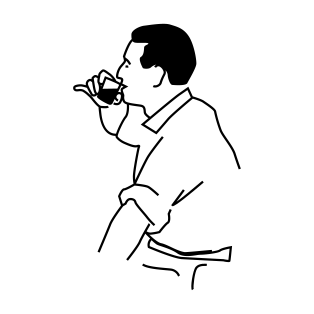
In the south of the Basque Country, Rioja Alavesa composes an idyllic landscape full of vineyards. The vine grown in this area is perfectly adapted to the land and climate of these more-than-310km2 of red-stained soil, which, divided into 18 municipalities, offer the most adequate conditions for this type of cultivation.
This is an area of transition for Atlantic and Mediterranean climatological influences, that is, a place between the humid north and the arid south, whose effects are lessened by some of the area’s orographic elements, such as the Toloño range. This makes sure that the vineyards get the right amount of sun and water. The vineyards grow on clayey, chalky soil on the sides of the Toloño range, forming terraces and little plots looking south in order to make the most of summer light.

We have various producers in Álava, Gipuzkoa and Bizkaia; and we have our office, slaughter, cutting and storage facilities in Zestoa (Gipuzkoa). We get a very fresh product thanks to the process of slaughter and quartering; the Basatxerri pig farms are less than two hours from the slaughterhouse and the cutting is carried out in facilities attached to the slaughterhouses, avoiding the transport of the carcasses.
This ensures superior meat quality and freshness. We achieve a product of maximum guarantee and freshness, thanks to the care of it in all stages of development, from growth and slaughter, to processing and marketing. We elaborate with local artisan suppliers, looking for those companies that make the most natural elaborations possible.
With all this, we guarantee the development of our baserritarras, the well-being of our animals and we offer the consumer a fresh product of the highest quality.
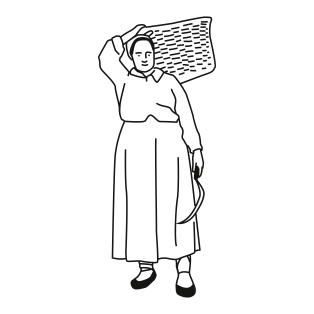
Extra Virgin Olive Oil from Navarra is the oil in Europe that is produced further north. This factor, together with the edaphoclimatic conditions of the production area (limestone soils, dry and sunny climate and strong thermal oscillations between day and night in the maturation period); and the need to harvest early to avoid the frost period, determine the low degree of maturity with which the olive is harvested.
Extra virgin olive oil obtained from the flight olives of the following varieties: Arróniz, Empeltre and Arbequina. The native variety Arróniz is considered the main variety, representing a percentage greater than 10% in the blend of the oil, giving the oil a characteristic profile, which can come from both the mixture of oil and the olives.
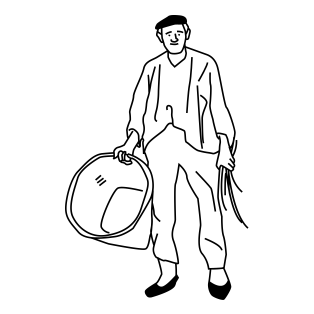
According to a document from the 16th century, at that time the salt mine had a well in which salt water was collected and 8 houses -dorlas- in Leintz Gatzaga, Gipuzkoa . In the houses there were as many iron boilers, of the same name, into which the salt water was poured. The heat produced by the wood placed underneath when burning allowed the water to be perfumed and salt to remain.
Production was only running from July to December. As the rest of the year it rained a lot, the amount of salt in the water was greatly reduced and the exploitation was not profitable. In those "holiday months" firewood was collected in the densest populated forests of the area. Today that neighborhood has been called Dorla.
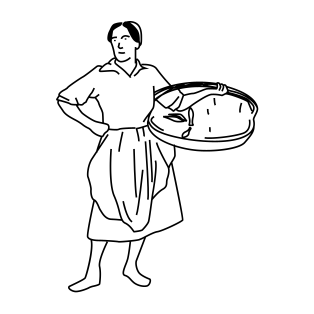
The coast of the Basque Country is one of the most important places in the Bay of Biscay in terms of canned fish. The quality of the jars and cans that come out of this sea is appreciated all over the world, but do we know why? It would seem evident that a land with such a fishing tradition is destined to develop its own canning industry, although this was not always the case. Food preservation methods consisted of rudimentary practices based on natural preservative substances until approximately the s. XVIII., when hermetic preservation was invented, which allowed food to be kept in good condition for a longer period of time.
This historical period coincided with the moment in which the Treaty of Utrecht stopped allowing Basque cod and whale fishing in the North Atlantic in favor of English vessels. This practice meant significant economic gains for the Basque coastal capitals, so, when it had to be abandoned, it was necessary to choose to direct efforts to other sectors -such as livestock - or focus fishing in the Cantabrian Sea.
This last option was embraced by the many fishing villages that, with great effort, managed to continue living from fishing, largely thanks to the preparation of catches as preserves.
The coast of the Basque Country is one of the most important places in the Bay of Biscay in terms of canned fish. The quality of the jars and cans that come out of this sea is appreciated all over the world, but do we know why? It would seem evident that a land with such a fishing tradition is destined to develop its own canning industry, although this was not always the case.
Food preservation methods consisted of rudimentary practices based on natural preservative substances until approximately the s. XVIII., when hermetic preservation was invented, which allowed food to be kept in good condition for a longer period of time. This historical period coincided with the moment in which the Treaty of Utrecht stopped allowing Basque cod and whale fishing in the North Atlantic in favor of English vessels.
This practice meant significant economic gains for the Basque coastal capitals, so, when it had to be abandoned, it was necessary to choose to direct efforts to other sectors - such as livestock - or focus fishing in the Cantabrian Sea. This last option was embraced by the many fishing villages that, with great effort, managed to continue living from fishing, largely thanks to the preparation of catches as preserves.
Navarra is distinguished by the great diversity of landscapes and climates that occur in the more than 100 kilometers that separate the north of the area, located near Pamplona, from the south, located on the banks of the Ebro.
Navarra is in an exceptional situation, practically unique in the Iberian Peninsula: the confluence of the Atlantic, continental and Mediterranean climates. The proximity of the Bay of Biscay, the influence of the Pyrenees and the bonanza of the Ebro valley allow this varied climate. This makes Navarre a great orchard, with high quality products, piquillo peppers, asparagus, artichokes, potxas, etc... which are a delight fresh but no less preserved thanks to the canning tradition of the area. This canning tradition means that food arrives in perfect condition at the tables of the best restaurants and homes.

Cheese is one of the most widely used condiments in the world. It began as a simple way to preserve milk without spoiling it and has ended up being the passion of many gastronomy lovers. Basque cheeses are all sheep's milk cheeses, a characteristic that is noticeable on the palate. In the Basque Country we have cheeses for all tastes, smoked, with paprika, semi-cured, highly cured, etc.

El txakoli es un vino único, no existe en ningún otro sitio del mundo que no sea el País Vasco. Sus características están definidas por el tipo de uva Hondarrabi Zuri (Blanca) y Hondarrabi Beltza (Negra) además de por la ubicación de sus viñedos normalmente alrededor de los 400 metros de altura, su equilibrada acidez y su cercanía al mar.
Existen tres denominaciones de origen reguladoras, Getariako Txakolina, Bizkaiako Txakolina y Arabako Txakolina. Cada una de ellas se ajusta y regula por zonas pero siempre como mínimo comparten el 70% de la uva autóctona Hondarrabi Zuri. Etimológicamente, la Palabra Txakoli, proviene del Euskera (el idioma de los vascos) de “etxeko ain” (lo justo para casa). Esto es, era un vino que se hacía para el consumo de la propia familia en los caserios.